Introduction
What SWE-Lego-RL is and how the pieces fit together
SWE-Lego-RL is a framework for training coding agents with online reinforcement learning on real software-engineering tasks. It connects unmodified agent harnesses — Claude Code, OpenHands, OpenCode, Terminus — to verl-based policy optimization: every trial runs in a fresh Harbor sandbox, the task's own test suite produces the reward, and training data is captured at token level directly from the serving path.
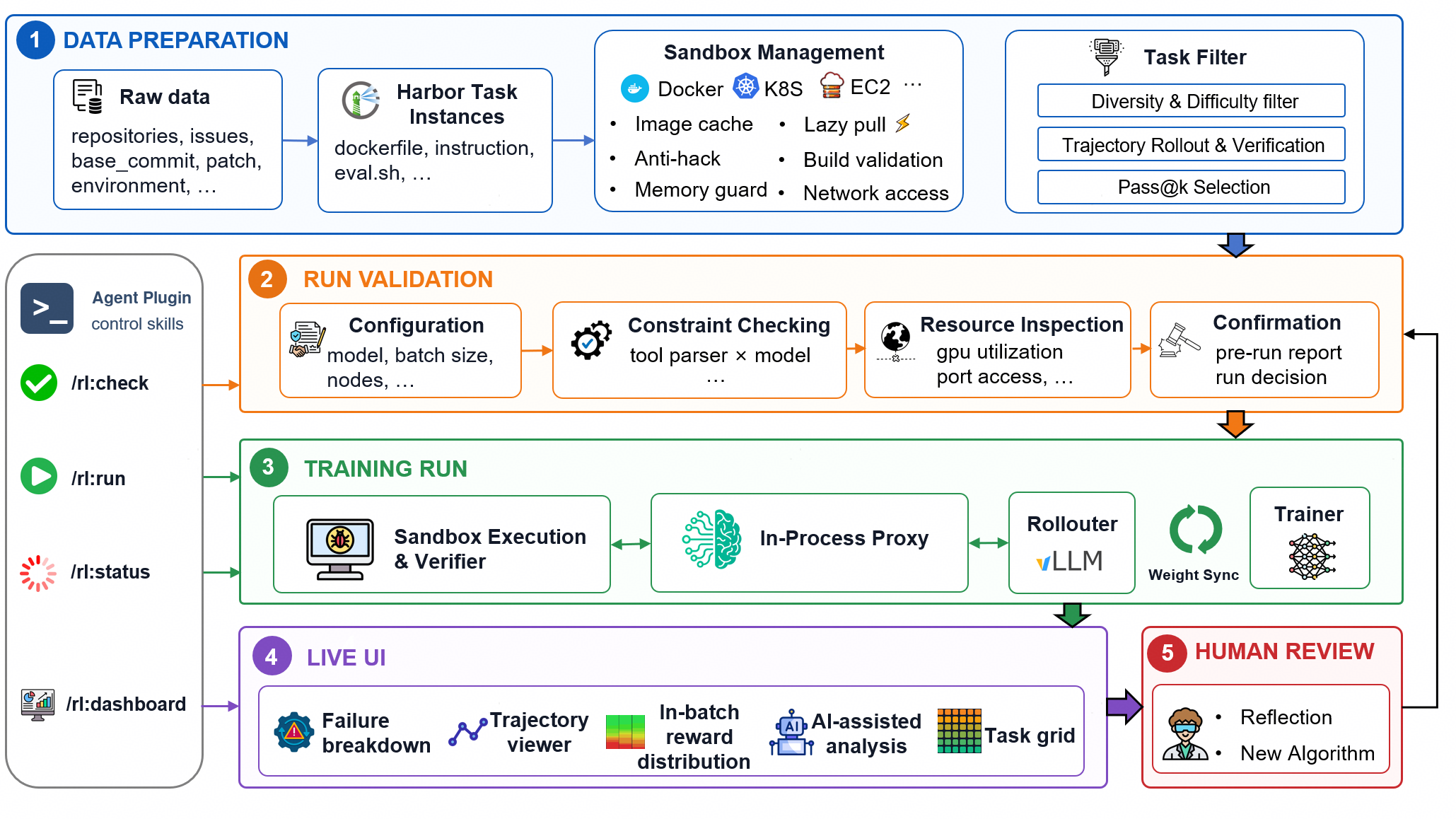
Key features
- Native agents, unmodified: the agent that produces a rollout is the same agent you deploy — each scaffold is a thin adapter, not a fork, and drives the policy it is training. Claude Code, OpenHands, OpenCode, and Terminus are validated end to end; any scaffold speaking the OpenAI/Anthropic API can be added as a custom adapter.
- Token-level trajectory capture: an in-process proxy serves one unified OpenAI/Anthropic API and records the exact token ids, masks and log-probabilities at generation time — no transcript re-tokenization, and history rewriting by the agent does not corrupt the signal.
- MoE routing replay (R3): rollout-time expert routing is recorded and
replayed during the update, keeping rollout/training log-probabilities
aligned (
pearson ≈ 0.999) for sparse policies. - Verified rewards in real sandboxes: each task's verifier runs its test suite inside a fresh Kubernetes or Docker container, with image caching, lazy pull, and anti-hacking defenses; broken environments are filtered out of the loss instead of polluting the gradient.
- Scalable training: PPO / GRPO / GSPO over full multi-turn rollouts, on FSDP, VeOmni, or Megatron; from a synchronous single-node loop to a fully-asynchronous multi-node cluster with partial rollout — see Scaling Up.
- Operations built in: Preflight config validation, an agent plugin for guided launches, a self-contained dashboard, and symptom-indexed troubleshooting.
The training loop
Each layer has its own page in Architecture:
- Environment: each task runs in a fresh sandbox (a Kubernetes pod or a local/remote Docker container — setup and permissions in Backends) with sandboxed execution plus the task's own verifier. A coding-agent scaffold — Claude Code, OpenCode, OpenHands, Terminus 2 — drives the model through the task.
- AgentLoopWorkers: run the scaffolds concurrently and capture each rollout.
- In-Process Proxy: fronts every worker with a single, unified OpenAI/Anthropic API — it captures the trajectory (token-in / token-out) and forwards each call onward. No standalone LiteLLM.
- Global Load Balancer: spreads requests across inference replicas with sticky, per-session routing.
- Rollouter: a pool of vLLM inference servers serves the policy, streams completed rollouts into a Data Buffer, and receives Weight Sync updates.
- Trainer: verl consumes the buffer, computes advantages, and updates the actor (PPO / GRPO / GSPO), then syncs new weights back to the rollouter for the next round.
Documentation map
- Getting Started: prerequisites and your first training run
- Data Preparation: raw issues → Harbor tasks, sandbox images, and a filtered task index
- Example Usages: launch and monitor training, evaluation, and batch inference
- Core Concepts: terminology, the training formulation, and references
- Block Design: the architecture, one page per block of the diagram above
- Agent Plugin: validate, launch, and diagnose runs through the
/rl:*skills - Dashboard: serve the training board in one command, locally or on a public URL
- Reference: the runner configuration surface